

Compelling, disturbing and strangely topical, this Bachman Book adaptation is as haunting as the original.
What’s a Bachman Book?
Stephen King’s short novel, potentially the first story he ever wrote, at the age of 18, was originally published under the pseudonym Richard Bachman. Apparently, King was so overly prolific that his publisher told him to stop writing. Having no ability to stop, he simply invented another writer to carry his obsession.
Also, like the other Bachman stories, it’s not a quintessentially Kingian horror story. It’s a gut-wrenching, visceral, rage-inducing adventure tale.
The Long Walk’s Plot
In a nutshell, the story takes place in a less-fictional-by-the-day future dystopia where a Civil War has torn apart the country and left it crippled, financially depressed and a shell of its former self. In an effort to motivate the populace, a yearly lottery takes place, volunteered for by every able-bodied young man. The 50 lottery ‘winners’ are selected to compete in an endurance test – where they start walking south from Maine and must maintain a speed of at least 3mph lest they get a warning. Three warnings buys a boy a ‘ticket,’ a euphemism for a bullet fired by a solider in the surrounding military cordon.
The Lore Behind the Novel
People who have read this book in adolescence can never shake it. This story becomes a totem, it becomes something you only talk about to people you trust. It is so dark, and yet somehow so real that it defies adaptation. 45 years after its inception, Hunger Games director Francis Lawrence managed to wrangle its essence into a 108 minute film that may compel you to take a break from watching movies for a few weeks. Or it could produce enlightenment in your heart. Or possibly both.
The Long Walk’s Allegories and Relation to The Hunger Games
On one hand, The Long Walk is a metaphor for everyone’s life. Death is inevitable — we are all on a grim march towards it, so how can we find meaning, knowing that we all face the same end?
On another hand, The Long Walk provides a commentary on today’s lust for political violence. There are themes of fascistic, jingoistic government, an impoverished populace, a demagogue transmuting their desperation into an orgy of death. It depicts young men torn apart by assault rifles, some while begging for death, some while revolting, some while soiling themselves. The movie is an orgy of violence that happened to release amidst a generational crescendo of political violence.
One could argue that we are closer to Stephen King’s imagined dystopia than we have ever been. That only this kind of spectacle can sublimate the violent urges of the masses. George Carlin talked about a similar idea in his material satirizing a prisoner-focused cable channel, The Violence Network.
And, as Francis Lawrence could certainly tell you, The Long Walk is the Dune to the Hunger Games’ Star Wars.
How The Long Walk’s Stars Were Forced Into Meisner
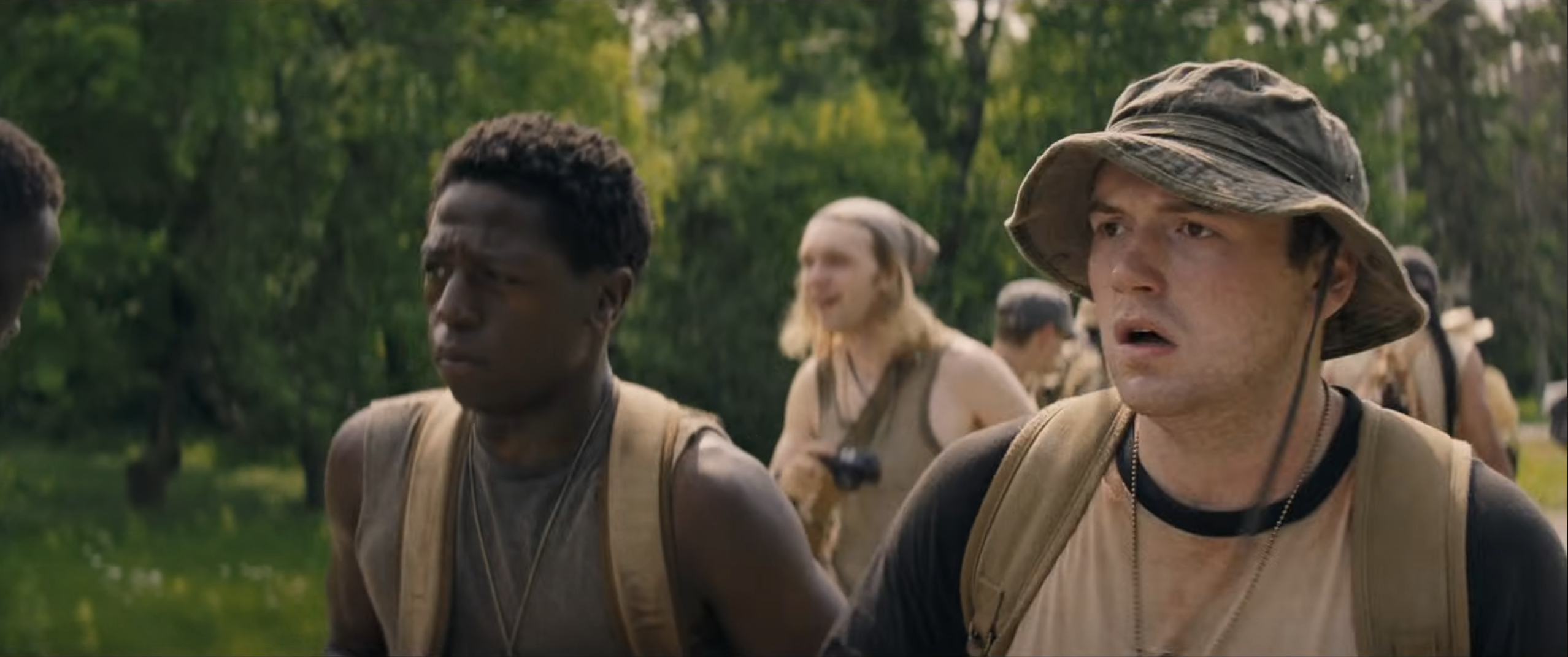
I haven’t even yet mentioned the unbelievable performances by Cooper Hoffman (Philip Seymour Hoffman’s kid), David Jonsson and the young men who play the walkers. Mechanically alone, the film is a wonder. Every actor depicted is literally walking in every single scene of the film. Cooper Hoffman estimated that he and his co-starts walked over 15 miles a day during filming and over 400 total over the entire shoot.
As someone interested in physically-oriented acting and the Meisner-inspired technique of evoking emotion ‘Outside-In,’ shooting The Long Walk seems like a dream in Meisner — where instead of sedated actors stumbling out of trailers trying to conjure up a spirit of wrathful vengeance when hearing ‘Action!’ from the director – the actors are forced to put their physical selves into the physical reality of the characters.
These actors faced the very real threat of physical exhaustion while filming a movie about characters who fear their own physical exhaustion. No CGI, no body doubles, no Lucasfilm greenscreen treadmill holodecks. Just dozens of miles of beautiful countryside and no license to ever, ever stop.

